Skip to content
Help

FAQ

Helpful answers and expert advice on the care, health, and training of your Boston Terrier, prepared by our team.

Puppies are released once they are weaned and eating solid food, typically between 45 and 60 days of age.

All our puppies come with:

  1. Veterinary health check.
  2. Up-to-date vaccinations (depending on age; usually 1–2 doses covering Parvovirus, Coronavirus, and Canine Distemper).
  3. Up-to-date deworming (parasite control using various dewormers; 3–4 treatments administered between one week of age and the time of handover).
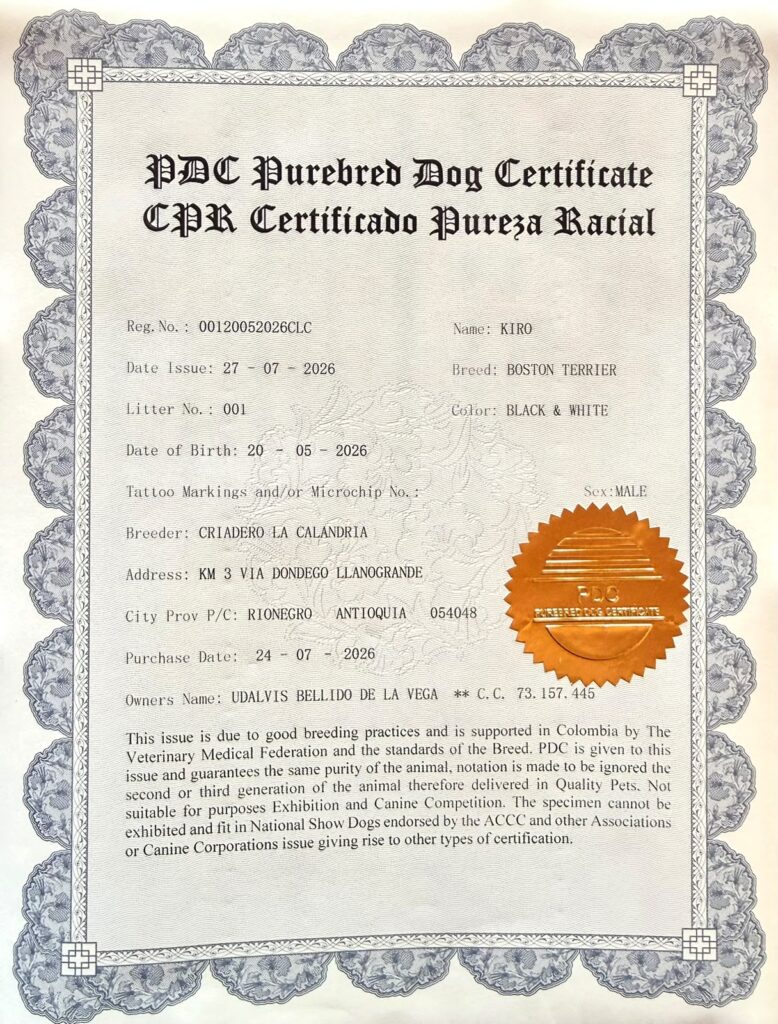
  4. Purebreed Dog Certificate (PDC).
  5. Care recommendations folder.
  6. Blanket and collar.

Purebred Dog Certificate (PDC) is an official document issued by a country’s kennel club or canine organization, certifying that a dog belongs to a specific breed. It is primarily issued when a dog meets the physical characteristics of the breed standard but lacks a complete genealogical history; nevertheless, the dog complies with all the breed’s genotypic and phenotypic parameters. Additionally, the certificate may include information such as the breeder’s details, the dog’s date of birth, its birth-order number, the parents’ history, and the owner’s information.

PDC serves as a guarantee, ensuring that you are investing in a dog with the expected lineage.

The PDC allows us to verify ownership of the dog, as the document lists its characteristics (name, breed, color, age, sex, etc.) and, in some cases, identification details (such as a tattoo number or microchip ID).

When acquiring a pet, it is important to have access to these records; they provide peace of mind that the dog meets the desired breed standard and assure you that the breeding facility followed responsible practices endorsed by the canine organization.

Acquiring a dog from a reputable breeder not only ensures a healthy animal but also supports responsible purebred breeding practices.

Keep the following points in mind:

  1. Know the history: Buying from a responsible breeder allows you to learn about the dog’s genetic and medical history, thereby reducing the risk of health issues.
  2. Certifications: Responsible breeders provide documentation regarding the breed’s purity and the puppy’s health status.
  3. Vaccination and parasite control records: Before taking possession of the puppy, ask to see the records of the vaccinations and parasite treatments it has received.
  4. Avoid resellers or multi-breed breeders: Many websites are not actual breeders but merely portals for animal resellers who claim to be specialists with physical facilities when, in reality, they are not. It is important to verify that the breeder has physical facilities and allows you to visit the premises.
    Before committing to getting a dog from a breeder, it is essential to verify their reputation and ethical standards. Start by researching online, looking for reviews from other customers and testimonials about their experiences. Social media and pet forums can be excellent resources for obtaining firsthand information about specific breeders. Often, the experiences of other buyers will give you a clear picture of the breeder’s quality.

It is also advisable to contact recognized breeder associations that can provide information on ethical breeders in your area. These organizations usually have a code of ethics that members must follow, which can help you narrow down your options.

Another way to verify a breeder’s ethical standards is to visit the facility in person. Observe the dogs’ living conditions, their behavior, and the care they receive.

An ethical breeder will have no problem showing you their facilities and answering your questions about their breeding practices.

Like all other breeds, Boston Terriers have their own health vulnerabilities. These dogs may be prone to certain conditions, and it is not always a matter of genetics.

While they do not suffer from major or frequent health issues, they certainly cannot be considered immune to all ailments. Fortunately, they generally enjoy excellent health.

Corneal Ulcer
Typically, the most alarming sign of this eye condition is watery eyes; a corneal ulcer in dogs is essentially a wound on the membrane covering the eye. The dog is often unable to keep the eye open because it causes discomfort. They may frequently try to rub the eye with a paw, displaying an expression of pain while doing so.

Cataracts
This is one of the most common eye problems, affecting both puppies and adult dogs; however, the juvenile form typically appears between 8 and 12 months of age. It is advisable to have regular veterinary check-ups throughout the dog’s life, as cataracts are often not clearly visible to the untrained eye.

Cherry Eye
“Cherry eye” refers to the prolapse of the third eyelid gland. It is a condition that primarily affects puppies under one year of age and can be treated either by surgically removing the gland or by repositioning it to its original location.

Patellar Luxation
This is a very common issue in small dogs, also known as a “slipped kneecap.” Essentially, the kneecap (patella) is misaligned, meaning the three components of the joint—the femur, patella, and tibia—do not function together properly to allow the dog to walk correctly.
A dog with patellar luxation will usually limp, though signs of this abnormal gait often become more apparent during the growth phase rather than at birth. This orthopedic condition is classified into four grades (with grade four being the most severe); visually, the dog may appear to have bowed legs.

Heart Murmur
Heart murmurs are quite common in Boston Terriers. While they can potentially progress to more serious conditions, affected dogs are often able to lead a normal, trouble-free life.
A murmur is essentially an audible sound—often described as a “whooshing” or “swishing” noise—caused by blood flowing back into the left atrium. In practical terms, this means the heart is not pumping enough blood to the rest of the body.
This condition should certainly not be underestimated; it is best to have your veterinarian monitor it closely. Treatment typically involves the use of diuretics and other medications, combined with reduced physical activity and lower sodium intake.

Generally, the Boston Terrier is a fairly energetic and lively dog ​​that needs physical activity to stay happy and healthy. That is why you should provide at least an hour of exercise daily, allowing the dog to run, play, and socialize. You can take him out on a leash for a couple of walks—ensuring at least one includes the chance to sniff, explore, and interact with the surroundings—and provide extra time for off-leash play in a safe area, such as a fenced yard.

It is worth noting that this little dog also requires proper socialization from puppyhood; you should allow him to interact with various people, other dogs, and different experiences. This helps him navigate his environment confidently and grow into a friendly companion. Just make sure he appears comfortable and secure in his surroundings before introducing him to anything or anyone new.

Furthermore, the Boston Terrier should receive training from the very first day he arrives home. Training sessions should be combined with exercise and conducted consistently using positive reinforcement—never hitting or shouting, but rather using treats and praise for good behavior. The good news is that this breed is quite intelligent, so teaching him to be a “good boy” is far from impossible; however, you must remain patient and consistent with the rules, and all household members living with him should do the same.

PDSA experts strongly recommend never leaving him alone for more than four hours. Doing so increases the risk of destructive behavior toward household items and the development of separation anxiety; this not only directly interferes with training but can also gradually affect his overall health. For their part, specialists from the American Kennel Club agree that the Boston Terrier is a lively little dog that needs physical activity to stay healthy and happy; they therefore recommend moderate exercise and opportunities to participate in canine sports—such as agility, obedience, flyball, and rally—which are fun ways to channel its energy safely.

House-training a new puppy can often be a challenge for a new pack leader, but the process doesn’t have to be stressful for either the human or the animal.

The truth is that, when it comes to training puppies, we have Mother Nature working in our favor. When puppies are born—whether in a kennel or a whelping box—the mother always cleans up after them; consequently, the scent of urine or feces is never present where the puppies eat, sleep, and live. As they grow, they learn to use outdoor areas by imitating their mother.

In this way, all dogs become conditioned never to use their dens as a bathroom. Between the ages of two and four months, most puppies grasp the concepts of crate training and going to the bathroom outside quite easily—thanks, in part, to their biological clocks.

One built-in advantage regarding house-training is the canine digestive tract, which is extremely fast and efficient. A puppy will typically want to defecate five to thirty minutes after eating. Therefore, with a consistent feeding schedule and a close eye on the clock, you can ensure your puppy maintains a regular bathroom routine

During the early days of training, you must also ensure your puppy has a safe place to relieve itself—a spot that looks and smells familiar. Have you noticed how dogs often relieve themselves in the same place they did before? That is because the scent acts as both a trigger and an attractant.

As always, remember that your own energy plays a crucial role in your training efforts. If you feel nervous or impatient, or if you try to rush the puppy, it can become stressed. Using a loud or high-pitched voice to encourage your puppy to “go” can be distracting, so try to avoid chatting while doing so.

Establish a routine and stick to it. Choose a specific spot for your puppy to relieve itself and take it there at the same time every morning. Repeat this every three to four hours, as well as twenty minutes after meals. Also, keep in mind that after a nap, your puppy will likely need to go. Consistency throughout the process is vital for the puppy to adopt this new habit.

Once your puppy successfully relieves itself, it is important to reward the good behavior. It doesn’t need to be a huge, noisy celebration; a simple, calm word of approval or a treat is enough to convey that it has done a good job.

Do not punish your dog for accidents, and avoid anything that might create a negative association with its bodily functions. Remain calm and positive, and gently guide the puppy to the designated spot.

When done correctly, house training shouldn’t be chaotic; it is simply a matter of putting in a little extra effort to get your puppy accustomed to a schedule during those first few weeks at home. Don’t let unnecessary stress over this natural and straightforward process overshadow the joy of training your Boston Terrier puppy.

There are many psychological reasons why puppies chew on items in their environment, such as anxiety, boredom, sore gums, or hyperactivity.

If you have a two-month-old puppy at home, this behavior is normal, as it is often caused by teething pain. To prevent the habit of chewing on inappropriate items from forming, it is advisable to provide toys, balls, and bones for the puppy to play with.

Before giving them any object, ensure it is neither toxic nor harmful to their health and is the right size to prevent choking. Squeaky toys are often a favorite among puppies, though the noise can be annoying.

You should never give them old shoes or personal items belonging to humans, as the dog will not be able to distinguish between an old shoe and a new one.

If the dog prefers household objects despite having its own toys, you must keep a close eye on it so you can correct the behavior the moment it tries to chew something. If you catch the dog chewing on something like a sofa leg, you need to be firm and decisive. A sharp “NO” will signal that the behavior is unacceptable; immediately afterwards, you should move the dog away from the area and offer it one of its own toys to chew on instead.

NO TO VIOLENCE

Physical punishment and violence should never be used. Rolled-up newspapers are not an effective training method.

Puppies often chew on various objects when their owners are away. Scolding or punishing them for this is pointless and absurd. Regardless of the mess they might make, the expensive furniture they might break, or the valuable items they might destroy, physical punishment should not be used; it will only turn your pet into a fearful animal.

LET THEM EXPLORE

When you are home, allow the dog to play and explore every corner, but always under supervision; a moment of inattention can be the perfect opportunity for the dog to destroy everything within reach. You need to intervene proactively with a firm “No” when the dog starts sniffing a table leg or a shoe.

IT’S A PROBLEM

If the dog is over a year old, the habit of chewing everything in sight is a problem. This behavior can be attributed to a lack of exercise, boredom, or anxiety. If you leave your dog alone for too long, boredom may well drive it to chew on whatever is within reach. A bored dog is capable of anything. In this case, the best approach is to exercise the dog before leaving it alone for several hours.

A five-minute walk just to relieve itself is not enough to burn off a dog’s excess energy. To prevent it from using that energy to destroy the house, you should tire it out with a walk of at least half an hour before leaving it home alone. Changing a dog’s routine is not easy—it requires time and dedication—but it is not impossible. In these situations, even with an adult dog, you can provide toys or bones to keep it occupied.

If the chewing behavior persists, the dog may be suffering from anxiety or another, more serious issue. Older dogs can suffer from a disorder known as Cognitive Dysfunction Syndrome, a condition similar to Alzheimer’s disease in humans. Among many other things, this disease affects a dog’s learning ability and memory. To treat such conditions, it is advisable to consult your trusted veterinarian.

Welcoming a puppy into the family is a very special moment, but you need to be prepared; puppies are delicate and require specific care and a suitable environment to view their new home positively.

1 Prepare their food and water bowls. It is crucial for the puppy to have designated spots in the house so they can learn to associate specific locations with specific activities.
Therefore, have their food and water bowls ready for their arrival.
We recommend using heavy materials so the bowls aren’t easily chewed or knocked over; however, avoid aluminum or metal, as the puppy could break them by biting and cause an accident.

Above all, keep them clean to prevent infections!
Remember to buy the specific food we recommend when handing over the puppy. You should not change brands for any reason, as this can cause gastric issues or even diarrhea. We will advise you on the most suitable food based on the puppy’s characteristics and the necessary daily portions.

2 Prepare their sleeping area. Just like the feeding station, it is very important for the puppy to have a specific place to rest—a spot they know they can go to.
It should be a comfortable bed where they can sleep peacefully. You can make the space more inviting by adding a toy.
Keep in mind that the puppy will likely want to sleep with you during the first few days, but it is important to get them used to sleeping alone if you don’t want them in your bed once they grow up.

3 Prepare a spot for them to relieve themselves. Your puppy cannot go outside until they have received all their vaccinations, so choosing the right spot for them to relieve themselves is very important. We usually hand over puppies with their initial vaccinations already done; check this blog for the vaccinations your new puppy needs before taking them out.
During the first few days, try to guide them to that spot so they can get their bearings. If they don’t go in the designated area, don’t scold them too harshly—it will take time for them to learn. Be prepared to mop the floor more than once… patience is key!

4 Puppy-proof your home. Beyond just setting up their specific areas, your home needs to be properly prepared. Remember, it’s just like having a baby! Their curiosity might lead them to chew on everything and explore every nook and cranny, so make sure to protect your furniture and cables. Don’t leave important or small objects lying around, as they could destroy or swallow them. You might want to install safety gates on the stairs.
If you have a garden, make sure to protect your plants, as some could be harmful. And above all—watch out for the pool!

5 Get chew toys and playthings ready. It is essential to have a selection of toys and chew toys ready for when the puppy arrives.
Chew toys will really help him learn how to chew properly (so he doesn’t chew on your belongings instead). As for toys, buy a few so he has variety or can choose his favorites. Remember, a puppy always wants to have fun.
Make sure the items are high-quality, non-toxic, and safe, so they won’t cause your puppy any harm.

6 Get hygiene and grooming products ready. You will need a few products for the puppy’s care during these first few days, such as shampoo, a brush, gauze pads, and towels (make sure they are specifically for animal use).
Remember, you don’t need to bathe him on the very first day; he will have enough to deal with just getting used to his new home. Wait at least a week for him to settle in.
Hygiene is always important, but you need to be especially careful when they are this delicate. Therefore, if you have any questions about which products to use or how to use them, we recommend asking your pet’s veterinarian.

7 Get the leash, collar, and crate ready. Even though he can’t go for walks yet, it is important to get him used to wearing a leash from time to time so it doesn’t feel strange when he is finally able to go outside.
It is also very important to have a crate ready at home (which is likely how you brought him home in the first place). It is the best way to transport him when you need to take him to the vet for vaccinations or check-ups.

One of the most playful, affectionate, and patient breeds in existence—and the first breed to originate in the United States. Join us to learn more about the Boston Terrier.

BREED ORIGIN
The Boston Terrier is the first true breed to originate in the United States. Information regarding its origins is far more detailed than that of other breeds, as the original breeders kept comprehensive records of the breed and all associated breeding practices. Around 1870, William O’Brien of Boston, Massachusetts, sold a dog he had imported from England—named Judge—to Robert Hooper, also of Boston. It was then that the dog acquired a new name: Hooper’s Judge, recognized as the true ancestor of the modern Boston Terrier.

Hooper was the result of a cross between an English Bulldog and a White English Terrier; he was bred to be an efficient fighting dog. Physically, he was described as a sturdy, tall dog weighing approximately 14 kilograms, with a dark brindle coat and a white stripe on his face. He had a square head and a nearly even bite. Subsequently, Hooper’s offspring were crossed with French Bulldogs and Pit Bull Terriers to refine the breed’s characteristics while maintaining a compact size and a sociable yet tenacious temperament. Between 1900 and 1950, the AKC registered more Boston Terriers than any other breed; according to the association’s 2017 records, Boston Terriers ranked 21st in popularity.

ORIGIN OF THE NAME
The name was evidently chosen based on the breed’s place of origin: the city of Boston, USA. The initial name coined for these dogs—before they were officially recognized—was “Round Heads.” The breed’s name was formally established in 1891, when the first Boston Terrier Club in America was founded.

To protect your dog from the noise of fireworks: block out the sound by closing windows and doors, create a safe space indoors, use white noise, provide exercise beforehand, use gentle pressure wraps, place cotton in their ears, use synthetic pheromones, and consider natural supplements like tryptophan or valerian. Keep their ID tag up to date, stay calm, and prevent them from ingesting firework residue. If you suspect your dog has ingested firework residue, contact a veterinarian immediately.

Some points to consider before getting a Boston Terrier—or any pet.

  1. They need your time and energy
    It takes a significant amount of time to play with, walk, and train them, and even to take them to veterinary appointments—not to mention feeding and grooming them. All these tasks are essential for keeping your pet healthy and happy.
  2. Your home needs to be ready for them
    Your pet will always need a comfortable place to sleep and shelter from the rain and sun. Although the Boston Terrier is a small breed, it still needs space to play and run; if you have common areas in your residential complex or near your home, keep this in mind.
  3. Pets get sick
    That’s right—just like humans, they can develop an ailment when you least expect it. Even when they are healthy, you need to take them to the vet for check-ups and vaccinations.
  4. You have to train them
    Just as with a child, you need to focus on socializing and training them so they can coexist with other people and animals.
  5. They need your affection and attention
    And they need it all the time—not just at the beginning of your friendship.
  6. The whole family should share the responsibility
    That’s right: every member should handle some aspect of the pet’s care. Whether it’s parents, grandparents, or children, everyone will be involved with the new family member.
  7. A Boston Terrier will change your life
    And they can bring you so much happiness! They will also change your schedule, your routine, and your priorities—everything! But remember, it will be filled with happiness. All pets have feelings and emotions just like us. They experience loneliness, happiness, anxiety, joy, and empathy… and they will give a lifetime of loyalty and love to anyone who commits to being a responsible owner!

Before starting the puppy’s vaccination schedule, the dog must be dewormed; this process is typically initiated by the breeder. At our kennel, for instance, we administer 3 to 4 rounds of deworming before the puppy is handed over.
The vaccination schedule begins at 45 days of age, provided the puppy is in perfect health—meaning no fever and no symptoms such as coughing, nasal or eye discharge, diarrhea, vomiting, lethargy, loss of appetite, extreme thinness, or skin problems (in short, the puppy must be in excellent health).

It is important not to administer vaccines before this age because maternal antibodies can block the development of immunity. (La Calandria Kennel ensures the puppy has received this initial vaccination before handover, and this can be verified in the vaccination record provided with the dog).

Puppy Vaccination Schedule
Age: 45 to 60 days

Parvovirus (45 days)
Canine Triple Vaccine (60 days)
Parvovirus Booster (75 days)
Canine Triple Vaccine Booster (90 days)
Hexavalent (including Rabies) (120 days)
Kennel Cough (optional) (KC)*

Adult Vaccination Schedule
One year after the administration of the Hexavalent and rabies vaccines, the following vaccines should be administered during adulthood:

-Hexavalent (Annual booster).
-Kennel Cough (KC) with revaccination every 6 months (especially for dogs that come into contact with other dogs).

If dealing with an adult dog suspected of never having been vaccinated, the Annual Booster (Hexavalent) should be administered.

The vaccination schedule is subject to change based on veterinary judgment.
You may notice that different veterinarians use different vaccination protocols; however, all of them can achieve the same level of protection. In particular, the protocol shared here is the one used by our veterinarians at the La Calandria canine facility and with our adult dogs.

Testimonials

What our families say

4.6 · 48Google reviewsView on Google
CARLOS ALBERTO SEGURA

CARLOS ALBERTO SEGURA

★★★★★ a month ago

Hoy visité el criadero, he seguido esta raza desde hace unos meses y me ha llamado mucho la atención. En el criadero me dieron una excelente asesoría Voy a esperar una próxima camada ya que lo necesito para mi sobrina en diciembre !! 🐶

View on Google
elisa pelaez

elisa pelaez

★★★★★ 2 months ago

Me encantó el criadero y la atención, reservé una linda perrita y ya estamos ansiosos por recibirla, nos dieron muy buenas referencias antes de ir, conocimiento en la raza. Me gusta que no son revendedores y sólo crían esta raza.

View on Google
Juan Carlos Zapata

Juan Carlos Zapata

★★★★★ 8 months ago

Tuve una excelente experiencia con este criadero de Boston Terrier. Desde el primer contacto, la atención fue muy profesional y amable. Se nota el amor y compromiso que tienen por la raza. Me entregaron un cachorro sano, feliz y bien socializado. Estoy muy agradecido por el acompañamiento y toda la información que me brindaron. ¡Totalmente recomendados!

View on Google
Christian Garcia

Christian Garcia

★★★★★ 9 months ago

Muy atentos, super buen servicio y se nota el cuidado con el que tienen los cachorros, recomendados 100%

View on Google
Alejandro Candela

Alejandro Candela

★★★★★ 11 months ago

Excelente servicio al cliente, te mantienen al tanto del proceso del cachorro desde el inicio, acompañamiento antes durante y después de la compra. Cumplidos en tiempos Excelente calidad de los ejemplares Recibimos nuestro cachorro por vía aérea sin ningún problema, llegó totalmente sano. Si buscas un Boston terrier este criadero es el lugar. Se ve que los tratan con mucho cariño debido a que cachorrito llega sin temor alguno al contacto humano, super consentido.

View on Google